

BTS’s Concert Reveals Huge Flaw In Korea’s Concert System
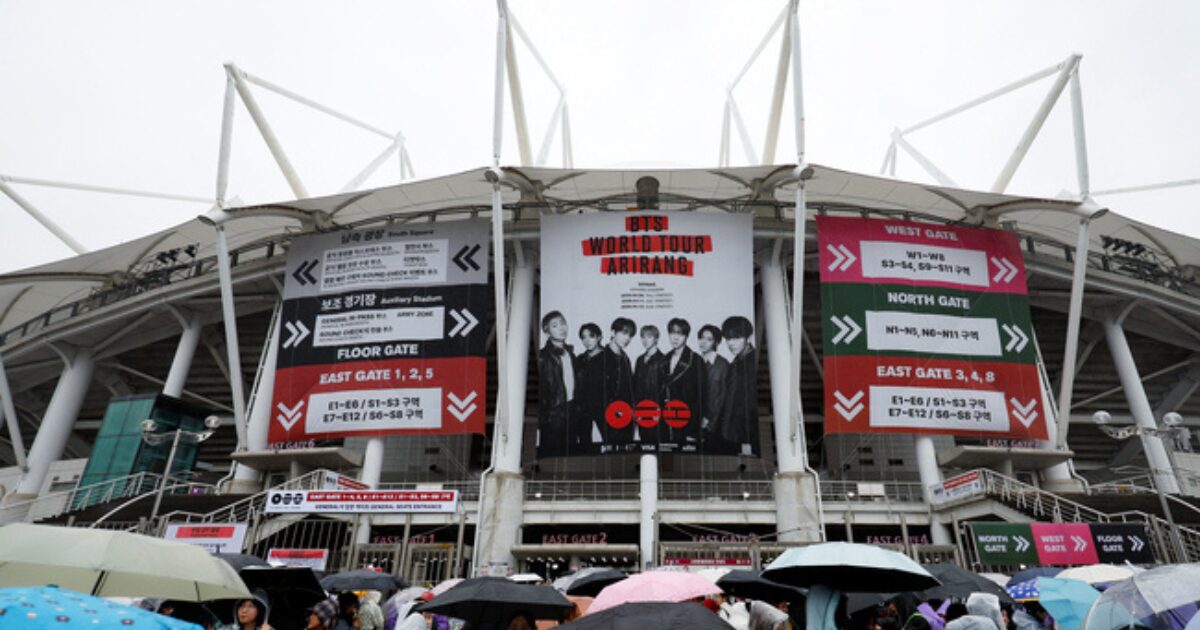

BTS’s recent concert has spotlighted a major issue within Korea’s live entertainment industry—the lack of proper large-scale concert venues.
Despite being one of the world’s biggest groups, BTS was forced to kick off their world tour at Goyang Sports Complex, an aging, roofless stadium on the outskirts of Seoul that has long struggled financially. While global demand for K-Pop continues to surge, agencies reportedly say they have “no other choice” but to use limited venues like this due to a severe shortage of suitable spaces.
On a rainy weekend, fans of BTS from all over the world flocked to Goyang City. The stadium that opened the world tour on April 9 is far from the glamorous global venues where this supergroup will perform next year. It is a decades-old, roofless soccer stadium located on the outskirts of Seoul, and for most of its existence since its establishment, it has suffered from financial losses.
However, Park Ji Hye, the official in charge of leasing the 40,000-seat Goyang Sports Complex, said that agencies representing K-pop stars “say this is the only option,” adding that “they complain they have nowhere else to go.”
The New York Times (NYT) reported on the reality that South Korea, where K-Pop is growing dramatically, lacks sufficient venues for popular culture performances.
The Goyang Sports Complex, where BTS held their first concert, clearly shows the paradox South Korea is facing. The country has not been able to build enough venues to accommodate the stars who have grown its music industry into a multi-billion dollar business. The reasons cited include soaring ticket demand, massive capital costs, land shortages, and complex lawsuits and bureaucratic obstacles.

Major cities around the world are also facing a shortage of concert infrastructure. However, in the Seoul metropolitan area with a population of 26 million, the popularity of live music continues to surge, making the venue shortage even more pronounced. According to government data, last year’s nationwide concert ticket sales reached a record high of $1.2 billion (approximately 1.6 trillion KRW), a 19% increase from the previous year.
The recent closure of large venues has further worsened the shortage. Jamsil Olympic Main Stadium (70,000 seats), which has hosted major concerts, has been under renovation until at least December this year. In the case of Seoul World Cup Stadium (66,000 seats), concert bookings have been reduced due to ongoing complaints that stage installations have damaged the grass used by professional soccer teams.
A new 28,000-seat venue is currently under construction in Seoul, aiming for completion next year. Until then, smaller venues are being used as alternatives, but they are far from sufficient given that the concert industry typically requires venues with over 30,000 seats to ensure profitability.

The shortage of venues is also leading to increased financial burden on fans. During a recent fan meeting for boy group NCT Wish in Seoul, a ticket reseller explained to buyers that the 11,000-seat indoor gymnasium was too small to meet demand, resulting in inflated prices. One buyer said they paid about ₩400,000 KRW (about $271 USD), nearly four times the original price.
According to industry experts, Korean fans are even missing out on mega concerts by global pop stars. Promoter Yoon said that Madonna and Adele skipped Korea during their Asia tours in the 2010s due to the lack of suitable large venues. For the same reason, experts say Taylor Swift also performed in Tokyo but not Seoul during her 2024 Asia tour.
Amid this situation, the once-neglected soccer stadium, Goyang Sports Complex, has paradoxically transformed into a highly sought-after concert venue. After sitting largely unused for its first 20 years, it has hosted global artists such as BLACKPINK, Coldplay, Oasis, and Travis Scott over the past two years.
Of course, the stadium has undergone renovations to improve crowd management infrastructure, such as pedestrian bridges and shuttle bus routes, but it is still far from perfect. Attendees complain that it takes over an hour to travel from some parts of Seoul. There are also environmental constraints. A middle school is located right next to the stadium. During BTS’s rehearsal on the 9th, which overlapped with school hours, the full sound system could not be used. Park explained that BTS had to rehearse using only in-ear monitor volume audible to performers and staff. And that evening, due to the limitations of the roofless outdoor stadium, BTS had to perform in pouring rain.
JUNGKOOK drenched in the rain, yet still delivering such emotional vocals against all odds. That’s BTS’ MAIN VOCALIST right there!pic.twitter.com/eHoPpEqTJp
— JUNGKOOK BASE (@jkpopbase) April 9, 2026
The problem has only worsened as major stadiums undergo renovations or restrict concerts, leaving few options that can handle large crowds. As a result, competition for bookings has intensified, ticket prices have soared, and even global superstars have skipped Korea due to the lack of infrastructure.
Ongoing delays in new arena construction, caused by legal disputes, funding issues, and bureaucratic hurdles, have further deepened the problem, with some projects now pushed back to 2030.
In the meantime, outdated venues like Goyang Sports Complex have become the default, despite clear limitations such as long travel times, restricted sound systems, and exposure to weather conditions.

