

“Perfect Crown” Commits Historical Blunder In Recent Episode, Public Outraged
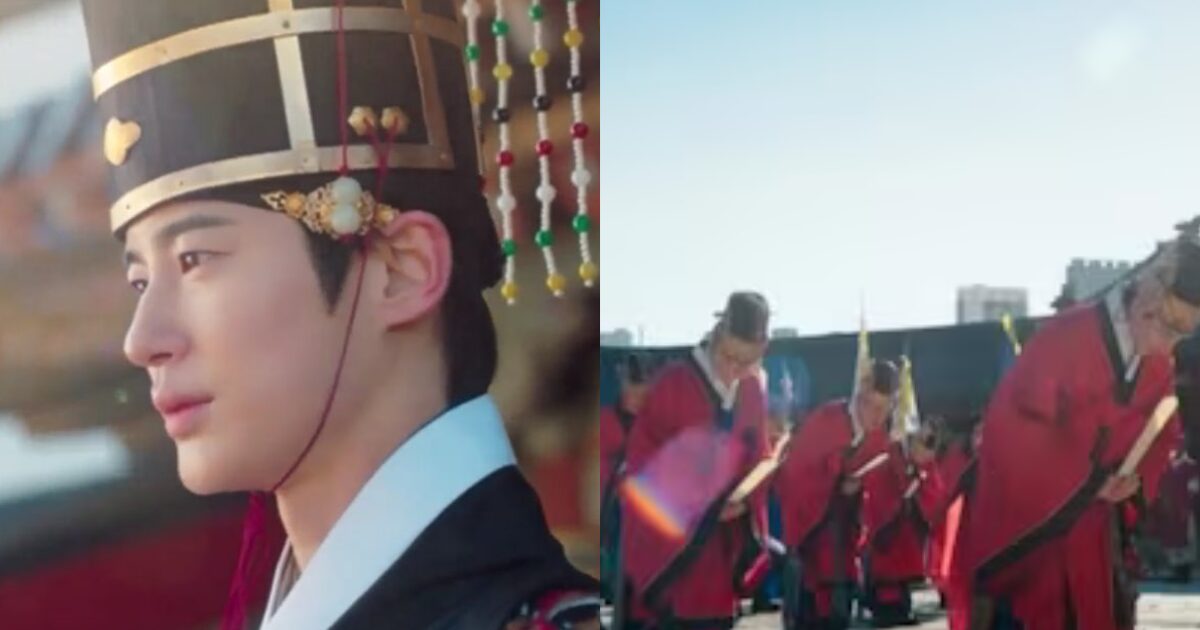

IU and Byeon Woo Seok-starrer Perfect Crown is facing massive pushback due to some major lapses in its historical detailing.

Perfect Crown is a love story that is set against the backdrop of a fictional modern-day South Korea, which operates as a constitutional monarchy. Hence, everything about the royal representation in the series has been subject to deep scrutiny, and the production team has already received criticisms over certain historical inaccuracies. However, for most of those cases, fans argued that some liberties had to be taken for the sake of the story.
However, in the recently aired episode of the K-Drama, there were two glaring mistakes that netizens simply couldn’t overlook. In episode 11, Byeon Woo Seok’s character Yi Ahn appears wearing the “Goryeo Myeonryugwan,” a nine-beaded royal crown, as he takes the throne, while his subjects shout, “Cheonse” (may the King live a thousand years).

Both these details have irked Korean viewers, since historically, the nine-beaded Goryeo Myeonryugwan was worn by Joseon-era kings while Korea was still a tributary kingdom to the Chinese empire. King Gojong attempted to fully renounce this tributary status in 1897 and formally declared Joseon an independent “Daehan Empire.” Since Yi Ahn appears to be ascending the throne of a sovereign Korea in the drama, the accurate crown for him would be the “Sibyi Myeonryugwan,” characterized by twelve beaded strands attached to the front and the back, symbolizing the sovereign rule of an independent nation.

The term used by Yi Ahn’s subjects, “Cheonse,” also struck odd to viewers as odd for a similar reason. When Korea was a tributary kingdom to China, subjects could only use the term “Cheonse” for Korean emperors, and the higher term, “Manse” (may the King live ten thousand years) was reserved strictly for the emperor of China. So, as the head of an independent state, Yi Ahn should have received the latter greeting.

Critics opined that these two small but significant mistakes in historical detailing potentially came across as the show undermining the sovereignty of Korea and trying to portray it as a vassal state. The backlash grew so strong that the production crew eventually issued a formal apology, accepting the criticism, and announced that the respective audio and subtitle of that specific scene would be modified to more accurately reflect the historical context.
